Robert is 76 years old. He spent 50 years as a pastor, and for most of those years he had a secretary. He'd dictate his thoughts from the books he was reading, she'd type them up, format and restructure them well, and that became the foundation of everything he preached. A clean system. It worked for decades.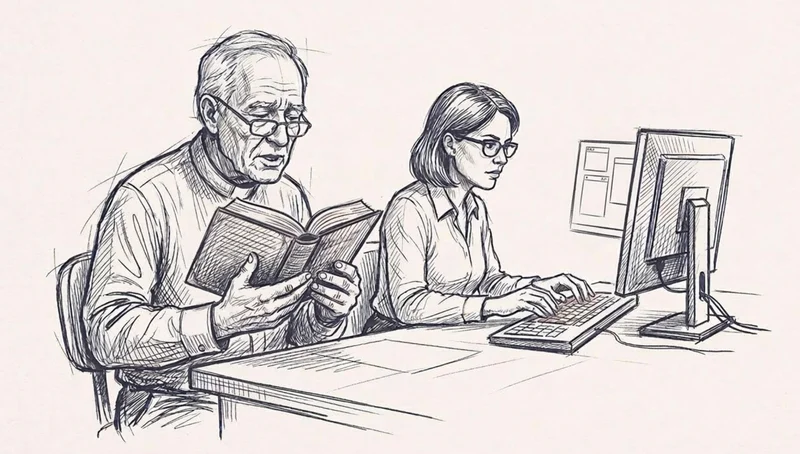
But in 2026, he doesn't have a secretary anymore.
He has AudioPen. It listens to what he says. It makes sense of it. It restructures it if needed, and rewrites it in a writing style of his choice. In one fell swoop, he goes from fuzzy thought to clear text, just by talking to his phone. No secretary needed.
Transformation, Not Transcription
Speech-to-text has existed since the 90s. But what most people actually need is not transcription. It is transformation. Taking the messy, half-formed thoughts, and turning them into something you could use.
That's the gap most voice-to-notes tools still don't close.
They give you exactly what you said. Every "um," every false start, every sentence you abandoned halfway through because your brain outran your mouth. They assume that what you want to say before you say it.
Raw transcription is useful if you're recording a meeting and need a legal record.
It is almost completely useless if you're trying to think.
AudioPen – A Detangler For Your Thoughts

Priya is a medical researcher in India. Every morning she puts in her AirPods, goes for a walk, and does what she calls a "brain dump" — she talks about whatever's on her mind. Sometimes it's a research problem. Sometimes it's a deadline she's anxious about. Sometimes it's both at once, tangled together. A mashup of fuzzy thoughts, exactly the kind of thing AudioPen excels at making sense of.
Priya doesn't need a transcript of her thoughts during that walk. She needs the signal extracted from the noise. She needs the three ideas worth keeping, cleaned up, structured, ready to drop into Obsidian where they become the seeds of research papers and Substack essays.
She calls AudioPen a "detangler for her thoughts." That's a better name for what voice-to-notes should be.
Yes, she could go to something like ChatGPT: Paste in a transcript and ask it to clean things up. But what you get back sounds like ChatGPT. Besides, it adds unnecessary complexity to what should be an elegant workflow.
So she uses AudioPen. One click of a button. And she can speak. Another click, and she has her thoughts restructured, ready for future reference.
Voice-to-notes, but on steroids.
Meeting Debriefs Done Differently

Derrick runs a company and sits on multiple boards. He spends his days in meetings he often can't legally record.
So he developed a habit: the moment a meeting ends, he pulls out his phone and dictates everything he wants to remember — who said what, what was decided, what was left hanging. AudioPen turns that stream-of-consciousness debrief into a structured memory protocol he could actually reference later.
No notes during the meeting. No awkward laptop in the corner. Just a five-minute verbal dump afterward that captured more than most people's handwritten notes ever did.
Voice-to-notes in a useful, repeatable form. No fluff, no fuss.
The Tool Has to Disappear
Two things kill a voice-to-notes tool faster than anything else: if it can't understand you properly, or if it rewrites your voice note transcript in a mechanical, AI generated style.
AudioPen has both those bases covered.
1. AudioPen perfectly understands any accent
Priya chose AudioPen specifically because it handles her Indian accent. If the transcription is wrong, nothing downstream works — the whole pipeline breaks at step one. Folks from all over the planet swear by AudioPen, irrespective of their preferred language, or accents. AudioPen uses the best speech to text models available, and will continue to do so as they evolve.
But even with perfect transcription, the tool fails if it flattens your voice. That's where AudioPen solves a problem that most other voice-to-notes tools don't.
2. AudioPen lets you adjust the intensity of its rewrites
AI generated writing sucks. It's almost immediately recognizable, and the universe doesn't need more AI slop. Handcrafted writing almost always reads better.
But the solution doesn't have to be one or the other. There is a middle ground.
AudioPen excels at it. Besides letting you define a writing style, it also lets you adjust the intensity in which that writing style is applied.
Want something that just corrects your grammatical errors, but leaves your prose intact? AudioPen can do it. Want something that completely restructures your text to make sure that it flows better? AudioPen can do it. Want something that just mimics the style of your voice based on the sample of writing that you've given it? AudioPen can do that too.
The sweet spot is restructuring without excessive rewriting. Keeping your phrases, your tone, your specific way of putting things, but organizing them into something coherent. With AudioPen, you can choose exactly the level of rewrite your notes are subjected to.
You talk, you get something useful, you move on. AudioPen does exactly that.
It's deceptively simple to use. Give it a whirl.
All names in this post have been changed to protect privacy.