There's a thing I keep seeing with a lot of SaaS tools – call it the Vending Machine Problem.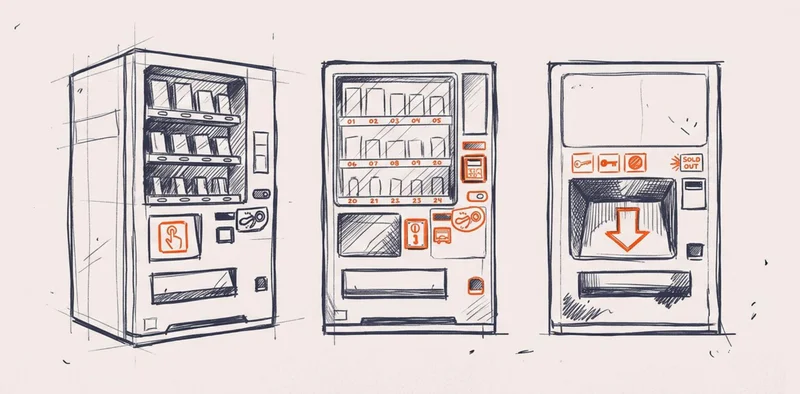
You build a product with one obvious input-output pair: voice goes in, meeting notes come out. Or prompt goes in, TikTok ready video comes out. That's the pitch. That's the App Store listing. And it's fine. It works. People buy it for that reason.
But the moment real humans get their hands on it, the machine starts dispensing things you never stocked. People find use cases they swear by, even if you never imagined them. When I built AudioPen, I was surprised to see the range of things people used it for. Here are a few:

The Complex Email Dictating Software Engineer
Nate is a software engineer. He doesn't use voice-to-text for meetings at all. He uses it almost exclusively for email. He jots down bullet points of what he wants to cover, then — his words, not mine — "vomits a speech" about them into the app. Out comes an email draft he can clean up in his mail client. He does this five or six times a week. His workflow isn't meeting notes. It's a drafting accelerator.
The CEO who can't record meetings
Stefan is a CEO who frequently can't legally record his meetings. So immediately after walking out of the room, he dictates everything he can remember: who said what, what was decided, what needs follow-up. It's a memory protocol — captured while the signal is still fresh, before the brain starts compressing and discarding. AudioPen captures everything and makes sense of things, so they're ready to be referred to in the future.
The filmmaker who writes letters in a different language
An 82-year-old Czech filmmaker is using a AudioPen to write letters in English to his friends in Scotland. He grew up in socialist Czechoslovakia with almost no access to foreign languages. He speaks into his phone in Czech and gets back English prose he describes as "absolutely perfect", better than anything Google Translate ever gave him. His name is Karel, and he is not the target user on anyone's landing page.
The Peruvian Shamanism Seminar Organizer
Veronica runs a small business in Switzerland organizing seminars on Peruvian shamanism. She knows the legends. She's lived inside them. But when she sat down to turn those stories into materials her students could follow, the page stayed blank. Not because she had nothing to say. Because she had too much, and no clean way to get it out.
So she started talking instead of typing. She speaks her thoughts into AudioPen, scattered, layered, mid-stream, and lets the app do the structural work she couldn't. It untangles her reflections into something a reader can follow without losing the feel of what she actually meant.
The Son who Writes Stories for his Mother
Then there's Marc. He records casual updates about his day while driving and sends them to his mother as structured stories. He could just send a voice note. But he wants two things a voice note doesn't give you: a chance to review before sending, and a readable format on the other end. He's choosing text over voice for the recipient's sake.
The Pattern Worth Naming
I'd call this Use Case Drift — what happens when a product's actual value diverges from its marketed one. Not in a bad way. The product isn't broken. People aren't misusing it. They're discovering adjacent utility that the maker never anticipated.
Meeting notes are the front door. But email drafting, memory capture, cross-language communication, relationship maintenance — those are the side entrances where the interesting traffic flows.
The instinct, if you're building the product, is to chase these use cases. Make features for each one. Build dedicated flows. But that usually kills the thing that made the drift possible in the first place: simplicity. A voice input and a text output. The narrower the tool, the wider the interpretation.
What This Actually Means for Builders
If you're making software, your App Store description is a hypothesis. Your users are running the experiment. And the results will look nothing like your assumptions — which is either terrifying or the most useful data you'll ever get, depending on your temperament.
None of these use cases — the email vomiter, the post-meeting memory dump, the 82-year-old Czech-to-English translator, the Peruvian Shamanism seminar creator, the mother-in-law story sender — would survive a product planning meeting. All of them are more interesting than "meeting notes."
I suppose the lesson is that the best features are sometimes the ones you never build. You just leave enough room for people to find them.
Which is a nice way of saying: sometimes the smartest product decision is doing less and getting lucky.
All names have been changed to protect user privacy.